Research

Fluid Flow

The transport of fluids. Harnessing colloidal dynamics and electrokinetic phenomena to enable pumping, mixing, and separation.

Pumping & mixing

Pumping drives fluid in a chosen direction, and mixing redistributes substances until the composition is uniform. At low Reynolds numbers, collective dynamics and electrokinetic effects can generate directed flows and stretch fluid streams, overcoming viscous resistance and accelerating both beyond diffusion alone.

Fluid transport

Driving controlled fluid flow through microchannels for precise liquid delivery and circulation.

Enhanced mixing

Generating local flows to accelerate mixing and improve uniformity at small scales.

Controlled reactions

Regulating fluid transport and mixing to improve reactant contact and maintain consistent reaction conditions.
Key toolbox elements

Multiphysics simulations Electro-magnetics Collective dynamics Vapor deposition 3D printing Surface engineering Microfluidics Lab-on-chip device

Related work

“Self-Assembled Reconfigurable Pump Architectures via Magnetic Colloidal Swarms”
Physical Review Applied (2024), 22, 064073
“Programmable Chiral States in Flocks of Active Magnetic Rollers”
Lab on a Chip (2021), 21, 215
“3D-printed molds for microfluidics … ”
In preparation
“Micro-Mixer Integrated Continuous Flow Electroporation Platform and Method for Loading Materials using the Same”
KR Patent Application (2026), No. 10-2026-0123605
“Self-Assembled Reconfigurable … ”
US Patent, invention disclosure submitted
“… metal carboxylate crystals … ”
Under review

Separation

Separation selectively removes unwanted components from a mixture. At low Reynolds numbers, external fields can guide and capture contaminants, supporting applications such as microplastic removal and impurity removal in semiconductor processing.

Microplastic removal

Selectively capturing and removing microplastic particles from water through controlled flows and external fields.

Semiconductor processing

Selectively removing particulate contaminants from process fluids to improve cleanliness in semiconductor manufacturing.

Biological separation

Selectively isolating and concentrating cells, vesicles, and other biological particles based on their physical properties.
Key toolbox elements

Calculation / modeling Multiphysics simulations Electro-magnetics Vapor deposition 3D printing Surface engineering Microfluidics Lab-on-chip device

Related work

“Directed Dielectrophoretic Assembly and Separation on Microelectrodes Patterned via Stereolithography 3D Printed Shadow Masks”
Lab on a Chip (2026), 26, 2486
“Method for Manufacturing Dielectrophoretic Electrode, Dielectrophoretic Electrode, Method for Separating and Assembling Particles using the Same, and Self-Healing Method of Dielectrophoretic Electrode Path using the Same”
KR Patent Application (2026), No. 10-2026-0080136
“Continuous isolation of … ”
Under review

Active particles

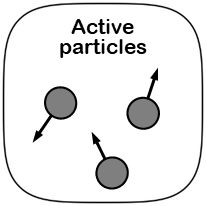
Active particles convert spatially uniform energy input into directed motion or mechanical activity by generating local gradients or asymmetric responses at the particle level. These modes of activity provide building blocks for collective behavior and controlled transport.

Self-propelling particles

Particles that convert energy into directed translational motion. Their movement enables active transport, cargo delivery, and collective migration.

Active spinners

Particles that convert energy into sustained rotational motion. Their rotation generates local flows and hydrodynamic interactions, enabling collective dynamics, fluid transport, and mixing.
Key toolbox elements

Calculation / modeling Multiphysics simulations Electro-magnetics Active particles 3D printing Microfluidics Lab-on-chip device

Related work

“Active Reversible Swimming of Magnetically Assembled Microscallops in Non-Newtonian Fluids”
Langmuir (2020), 36, 7148
“Engineering of Self-Propelling Microbots and Microdevices Powered by Magnetic and Electric Fields”
Advanced Functional Materials (2018), 28, 1705953
“Reconfigurable Engineered Motile Semiconductor Microparticles”
Nature Communications (2018), 9, 1791
“Propulsion and Assembly of Remotely Powered P-Type Silicon Microparticles”
APL Materials (2018), 6, 121102
“Supercolloidal Spinners: Complex Active Particles for Electrically Powered and Switchable Rotation”
Advanced Functional Materials (2018), 28, 1803465
“Active chiral spinners … ”
In preparation

See the full publication list →